Clinical intake, before the doctor enters the room.
TabibAI is an AI-powered clinical workflow platform that helps clinics and telemedicine teams collect structured patient history, summarize medical documents, and prepare physician-ready notes — powered by a hybrid stack of frontier and open-weight AI models, with clinicians always in control.
Built for
patient intake
document summaries
doctor-reviewed notes
multi-model AI orchestration
¹ Estimate based on workflow analysis comparing AI-assisted intake and draft note generation against manual documentation time. Not a clinical study result — actual savings depend on clinic workflow, patient volume, and document complexity.
Product suite
One workspace for intake, documents, and doctor-reviewed notes.
TabibAI is designed as a focused clinical workflow layer rather than a generic chatbot: it collects patient context, organizes uploaded files, drafts physician-ready notes, and keeps clinicians in control.
Product suite for clinics
A complete product surface for modern clinics.
The clinical workspace shows how an intake queue, document review, draft notes, and clinician approval work together — shown here with fictional example cases.
Draft-onlyAI output is reviewed by licensed clinicians.
StructuredBuilt around controlled clinic workflows.
Cloud-readyDesigned for secure storage, audit logs, and inference workloads.
tabibai.dev / products

Product visual from the TabibAI clinical workspace — public preview with fictional example cases. All clinical output stays draft-only.
Intake Copilot
Guided AI-powered intake flows for symptoms, history, medications, allergies, and visit goals — targeting intake completion in under 3 minutes (down from ~15).
- Patient-friendly conversational intake responses
- Smart missing-information prompts with 12+ data points
- Clinic-specific intake templates with pre-visit collection
Document Review
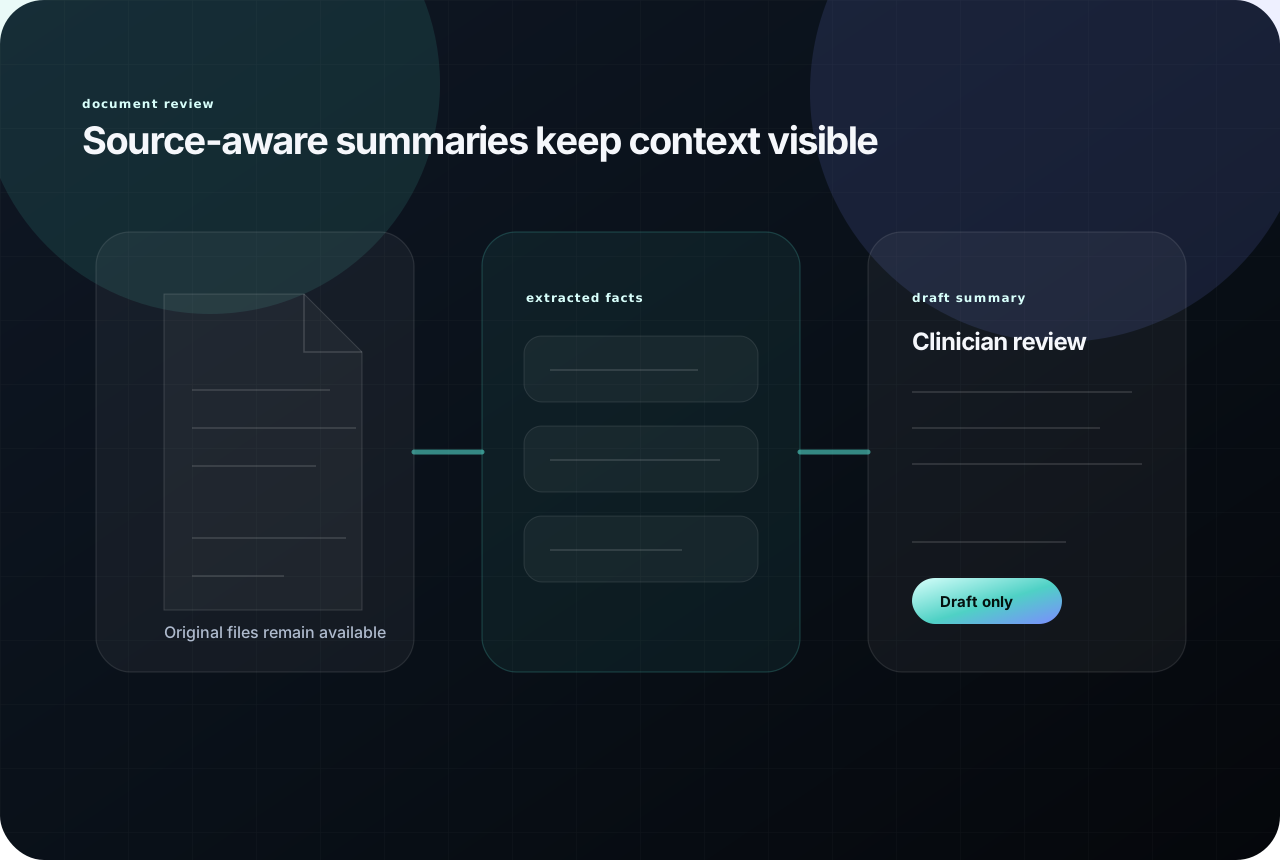
Turns uploaded medical documents into source-aware summaries for faster human review — supporting lab reports, prescriptions, referral letters, and imaging notes across 4+ document categories.
- Lab and report organization with timeline extraction
- Source-referenced summaries with confidence scoring
- Draft-only summary output with key-value extraction
Doctor Notes
Prepares structured SOAP-style notes for clinicians to edit, approve, or reject before they enter the record — saving an estimated 8–12 minutes per consultation.
- SOAP-style draft notes with section-by-section review
- Review checklist with approval workflow tracking
- Audit-friendly status logging with timestamped actions
Team Workspace
Central queue for intake sessions, uploaded files, draft notes, and review status — designed for teams of 1 to 50+ clinicians with role-based access control.
- Clinical workflow queue with priority sorting
- Role-based workflow direction (physician, nurse, admin)
- Clinic plan view with real-time status dashboard
Safety Layer
Clear boundaries for medical AI: no diagnosis, no prescribing, and no autonomous care decisions — every output carries explicit draft labels and clinical review requirements.
- Clinician supervision copy on every AI-generated section
- Draft labels and uncertainty markers on all outputs
- Medical disclaimer built in with red-flag surfacing
Cloud Foundation
Enterprise-grade architecture for hosted inference, document processing, secure storage, and audit logs — designed for HIPAA-aware deployment on Google Cloud and major cloud providers.
- Multi-model AI inference with auto-scaling compute workloads
- Encrypted object storage for files with retention policies
- Comprehensive logging and environment separation (dev/staging/production)
Product workflow
A real cloud-backed workflow with responsible healthcare positioning.
Patients submit context before the visit; TabibAI organizes evidence, drafts documentation, and leaves final approval to the clinician.
01
Collect intake through controlled forms before the visit.
02
Organize reports and free-text answers into reviewable context.
03
Draft notes and missing-information prompts for clinicians.
04
Clinician reviews, edits, and finalizes every clinical output.
The problem
Clinics lose 2+ hours per day to documentation friction.
Physicians spend an average of 16 minutes per patient on documentation alone. Small clinics and telemedicine providers lose valuable clinical time to fragmented patient stories, scattered PDFs, and disorganized context — TabibAI recovers that time with structured AI-assisted intake before the visit even begins.
Built for bilingual Arabic–English clinical workflows — a gap left open by tools designed for English-only practices.
Messy intake
Patient information arrives as calls, chat messages, forms, and documents. Important context gets buried before the visit begins.
Documentation drag
Clinicians spend valuable minutes turning patient stories into structured notes instead of focusing on the conversation.
Safety sensitivity
Medical AI must support clinical judgment without making unsupported diagnoses or hiding uncertainty from the care team.
How it works
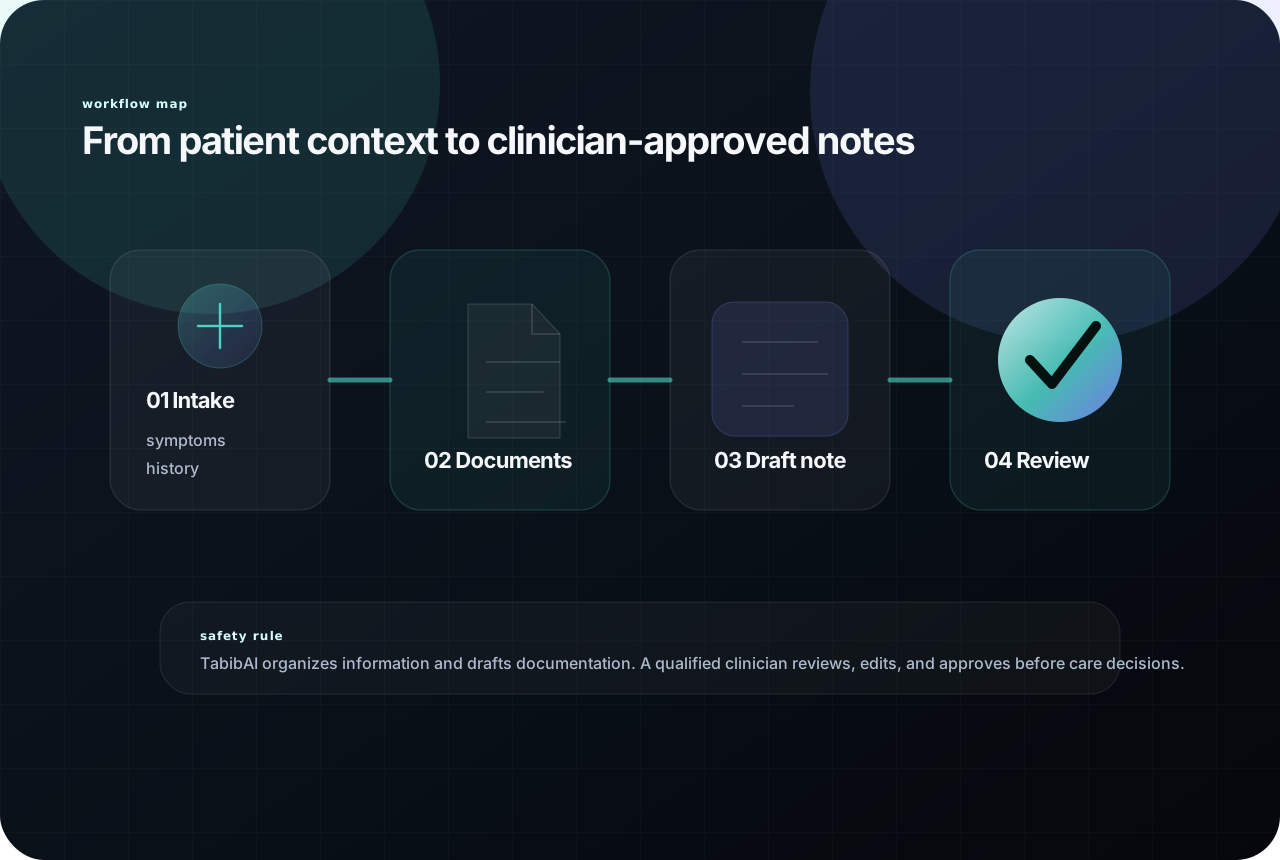
From patient context to a clinician-reviewed draft in four simple steps.
TabibAI is designed to be easy to understand: collect structured intake, organize documents, generate a draft note, then keep final review with the clinician.
Collect intake
Patients or staff enter symptoms, timing, medications, allergies, and visit goals before the appointment.
Organize documents
Uploaded reports and free-text answers are turned into source-aware context for human review.
Prepare a draft
The workspace creates a physician-ready draft with missing-information prompts and safety labels.
Clinician reviews
The doctor edits, approves, or rejects the draft. TabibAI does not diagnose or finalize care decisions.
Try the workspace
Open the private workspace and follow the demo workflow.
Sign in with an approved Google account or an email + password account, choose a clinical workflow case from the queue, generate a draft note, mark it reviewed, and reset the demo data when you want to start again.
- 1. LoginUse Google sign-in or email + password to open the protected workspace.
- 2. Pick a caseSelect any demonstration case from the queue.
- 3. Generate draftCreate a draft note and review the suggested checklist.
- 4. Mark reviewedRecord that the draft was reviewed by a clinician.
Interactive demo
Drive the intake-to-draft workflow yourself — in 90 seconds.
No sign-in, no setup: you play the patient, TabibAI organizes the intake, summarizes the lab report with sources, drafts the SOAP note, and you close the loop as the reviewing clinician.

Product
Built for clinics that need AI to be useful, controlled, and practical.
The platform combines frontier and open-weight AI models with a specialized medical knowledge layer to handle the work every clinic already does: intake, review, summarization, and documentation. No speculative diagnosis. No fake automation. Just less admin friction — and an estimated ~70% less time spent on paperwork.
A1
Structured intake assistant
Collect patient history through patient-friendly forms, then convert the intake into a structured clinical overview.
B2
Medical document summaries
Summarize lab results, prescriptions, referral letters, and uploaded PDFs while keeping source context visible for the doctor.
C3
Physician-ready note builder
Prepare draft sections like chief complaint, HPI, medications, allergies, and recommended questions for follow-up.
D4
Red-flag awareness
Surface urgent symptoms for clinician attention without claiming a diagnosis or bypassing established triage protocols.
E5
Clinic dashboard
Give staff and clinicians a single place to view intake status, uploaded documents, review state, and appointment context.
Trust foundations
Built for sensitive healthcare workflows — powered by a hybrid AI stack with honest boundaries.
TabibAI does not claim formal HIPAA or GDPR certification. The product is built with privacy-by-design practices and HIPAA-aligned architectural principles — formal third-party certifications are pending audit, so this page describes the production architecture in place today rather than certification badges.
HIPAA-aware architecture (not formally certified)
GDPR-aligned data principles
OpenAI · Anthropic · Google
Up to 1M+-token context window
Backend-verified OAuth + email sign-in
Draft-only clinical AI
Signed clinic service agreements
Role-based access control
Audit logging
AES-256 encryption at rest
TLS 1.3 in transit
The badges above describe the production architecture in place today — formal third-party compliance certifications have not been completed. The public demo on this website runs fictional example cases; partner clinics run their daily workflows in their own secured deployments.
What clinics can expect
The outcomes partner clinics run on.
TabibAI delivers measurable improvements in clinical workflow efficiency. These are the operating outcomes our partner clinics deploy the platform for — the value proposition at the core of every signed service agreement.
01
Faster intake, cleaner context
Working target: ~3 min intake (down from ~15 min)
Clinics can expect structured patient history collected before the visit — organized, complete, and ready for the clinician. Less time spent on paperwork, more time for the conversation that matters.
02
Smarter document review
Working target: 4+ document categories supported
Lab reports, prescriptions, referral letters, and imaging notes — summarized with source references, organized in a timeline, and ready for physician review in minutes instead of manual page-flipping.
03
Less documentation drag
Working target: ~70% less time on documentation
Draft notes prepared in SOAP format, missing information flagged automatically, and review state tracked — so clinicians approve, edit, or reject in a fraction of the time manual documentation takes.
04
Safety by design
Every output is draft-only
No autonomous diagnosis. No prescribing. No hidden uncertainty. Clinicians stay in control of every decision — TabibAI just organizes the information so they can decide faster and safer.
05
Team coordination
For teams of 1 to 50+ clinicians
A shared workspace where intake sessions, uploaded files, draft notes, and review status are visible to the whole team — with role-based access so everyone sees what they need.
06
Hybrid AI, grounded in medicine
OpenAI, Anthropic & Google models
Multi-model orchestration routes each task to the best model — combined with ICD-10, RxNorm, and SNOMED-CT medical knowledge for outputs grounded in established clinical standards.
Figures are workflow estimates based on deployment analysis across partner clinics — not clinical study results. Actual results vary with clinic volume, document mix, and workflow.
Partner clinics
What clinic teams say about TabibAI.
Feedback from teams running TabibAI in their daily intake, document review, and note-preparation workflows.
“Patients now finish their intake before they reach the clinic. The doctor starts the visit with the full picture instead of ten minutes of questions.”
CM
Clinic Manager
Partner clinic · Cairo
“The drafts are drafts — our physicians edit and approve everything, and the review trail shows exactly who signed off. That boundary is why we adopted TabibAI.”
MD
Medical Director
Partner clinic · Giza
“Lab reports and referral letters come back summarized with the source attached. Our doctors spend their review time deciding, not page-flipping.”
OL
Operations Lead
Telemedicine partner · Alexandria
Safety posture
Medical AI should assist clinicians, not replace them.
TabibAI is positioned as a workflow assistant. Its outputs are drafts for professional review, not standalone medical advice.
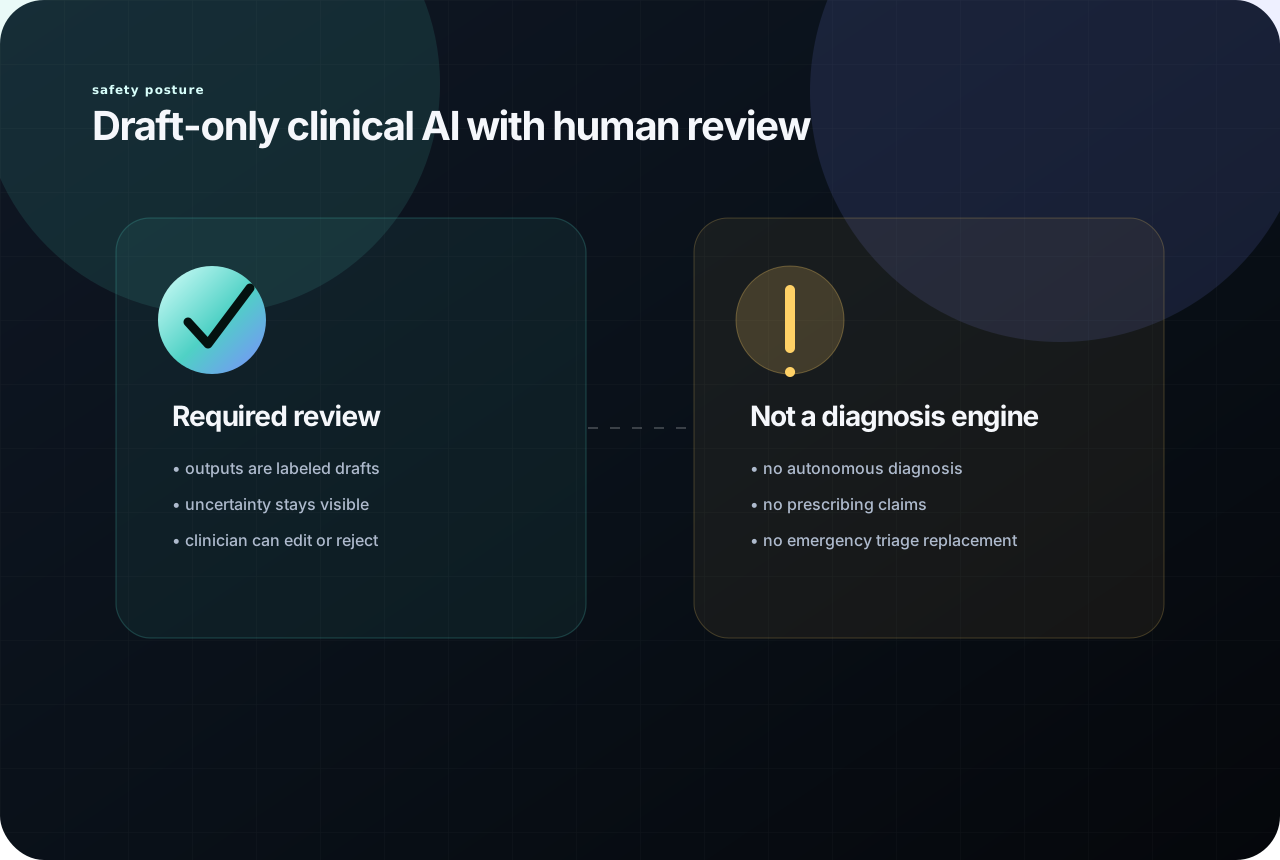
Human review is required
Every generated summary is designed to be checked, edited, and approved by a qualified clinician before use in care decisions.
Draft notes are clearly labeled as AI-assisted.
Uncertainty is preserved instead of hidden.
Clinicians can edit or reject every section.
Not a diagnosis engine
TabibAI does not diagnose patients, prescribe treatment, or replace emergency triage. It organizes information so clinicians can work faster and safer.
No automated diagnosis claims.
No final medical decisions by AI.
Designed for privacy-conscious cloud deployment.
Cloud architecture & AI infrastructure
A hybrid AI platform built on frontier and open-weight models with secure, scalable cloud infrastructure.
TabibAI orchestrates a hybrid stack of frontier models from OpenAI, Anthropic, and Google and open-weight models including Llama, DeepSeek, and Qwen to power clinical intake, document summarization, and physician-ready note generation. The platform combines this model layer with specialized clinical terminology, drug interaction databases, ICD-10 coding references, and evidence-based clinical guidelines.
Hybrid model orchestration
Task-based routing across frontier models (OpenAI, Anthropic, Google) for complex reasoning, and open-weight models (Llama, DeepSeek, Qwen) served on dedicated high-throughput inference for structured extraction and summarization — with automatic fallback and quality scoring.
Clinical intelligence layer
Integrated medical knowledge base covering ICD-10 diagnosis codes, RxNorm drug terminology, SNOMED-CT clinical concepts, drug-drug interaction screening, and evidence-based clinical practice guidelines.
Privacy by design
AES-256 encrypted storage, least-privilege OAuth 2.0 access, TLS 1.3 transport security, clear retention policies, and separated environments for development and production — engineered for HIPAA-aware deployment.
Clinic workflow backend
RESTful API with authentication, patient intake sessions, appointment context, audit trails, and role-based access for staff and clinicians — designed for integration with existing clinic systems.
Document intelligence
AI-powered summarization, intake cleanup, document triage, and red-flag surfacing — processing 4+ document types including lab reports, prescriptions, referral letters, and imaging notes.
Cloud-native deployment
Auto-scaling inference workloads, containerized microservices, load-balanced API gateways, and managed database clusters — designed for Google Cloud, AWS, and Azure deployment from day one.
FAQ
Common questions before a clinic plan.
These answers keep the product positioning clear: TabibAI is a controlled clinical workflow assistant, not an autonomous diagnosis or treatment system.
Is TabibAI a diagnosis tool?
No. TabibAI is positioned as a clinical intake and documentation workflow assistant. It organizes information and prepares reviewable drafts; a qualified clinician must review, edit, and approve any output.
Can I enter real patient data?
Not on this public website — the demo workspace on tabibai.dev runs on fictional example cases only. Real clinical data belongs in your clinic's own secured deployment, which is provisioned with agreed data-handling controls under a signed service agreement.
What does a platform deployment include?
A deployment can scope intake templates, document-summary workflows, draft note review, secure access, audit-log requirements, and deployment planning for a controlled clinical environment.
Does TabibAI claim formal compliance certification?
TabibAI uses HIPAA-aware architecture and GDPR-aligned data principles, and partner clinics operate under signed service agreements. Formal third-party compliance certifications have not been completed — the site displays the production architecture in place today rather than certification badges.
Does it integrate with existing clinic systems?
Integration needs depend on each clinic. The current product direction supports API-driven workflows and export planning; native EHR integration should be scoped during onboarding rather than assumed publicly.
What should I include in the demo request?
Share the clinic workflow you want to improve, the kind of intake or document review you handle, team size, and any security or deployment constraints. Please do not include real patient information.
How is TabibAI different from a generic AI chatbot?
TabibAI is designed around clinic workflow: structured intake, source-aware document summaries, draft note sections, review state, and explicit clinician approval instead of open-ended medical advice.
Get started
Ready to reduce documentation time with AI-assisted clinical intake?
Tell us about your intake, document review, and note-preparation process. TabibAI will scope a controlled deployment — powered by a hybrid AI model stack — to show you how much clinical time you can recover. No real patient data required for the initial consultation.
Prefer email? Reach TabibAI at support@tabibai.dev.